
Parent's Guide
Maths Struggles by Year Level
(And How to Help)
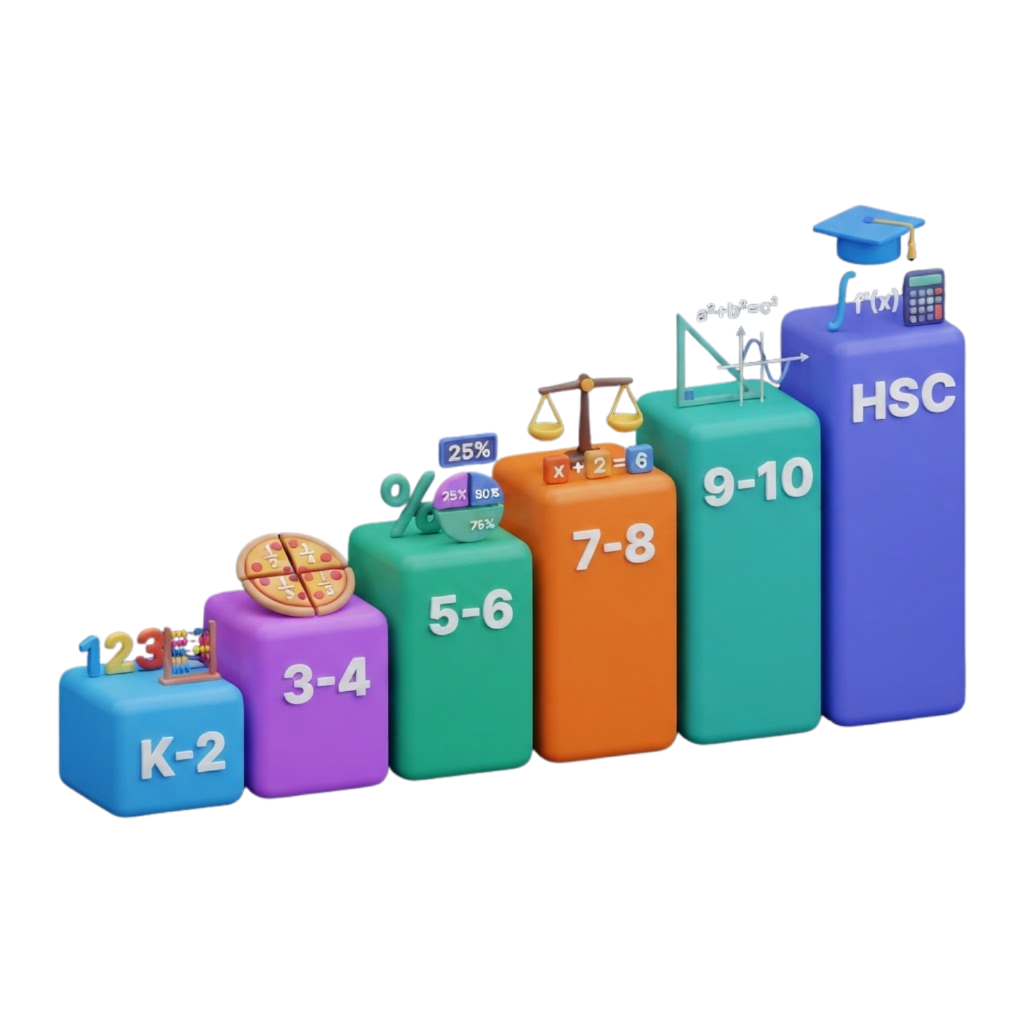
A year-by-year breakdown of the most common Maths challenges students face from Kindergarten to Year 12, with practical tips for parents on how to help at each stage. Identify where your child's gaps are and learn exactly what to do next.
If your child has suddenly started saying "I'm bad at Maths," they are not alone. Maths is the subject parents contact us about most, and the reason is almost always the same: a concept was missed or not fully mastered, and every topic since has been built on shaky ground. The good news is that once you understand where the gap is, it is fixable. This guide walks through the most common Maths struggles at each year level and what you can do to help.
Looking for a maths tutor? We provide one-on-one in-home maths tutoring on the Northern Beaches for all year levels, from Kindergarten through to HSC.


Kindergarten to Year 2: Number Sense & Confidence
In the early years, the biggest risk is not a specific topic, it is the belief that "Maths is hard." Children who develop Maths anxiety in Kindergarten often carry it for years. The most common struggles at this stage are:
"I can't do Maths" — or — "Maths is boring"
What you'll hear at home
Counting without understanding. A child may count to 20 but not grasp that 5 means five objects. This is called one-to-one correspondence, and it is the foundation of all future Maths.
Confusing number order. Writing 51 instead of 15, or not understanding that 13 comes after 12.
Avoidance. If your child refuses to engage with counting games or number activities, they may already feel behind.
How to help:
Use concrete objects, counters, blocks, or even snacks. Make Maths physical and visual before it becomes abstract. Celebrate effort, not just correct answers. If your child is in Year 1 or 2 and still struggling with basic counting or number recognition, early intervention with a primary maths tutor can prevent years of difficulty.
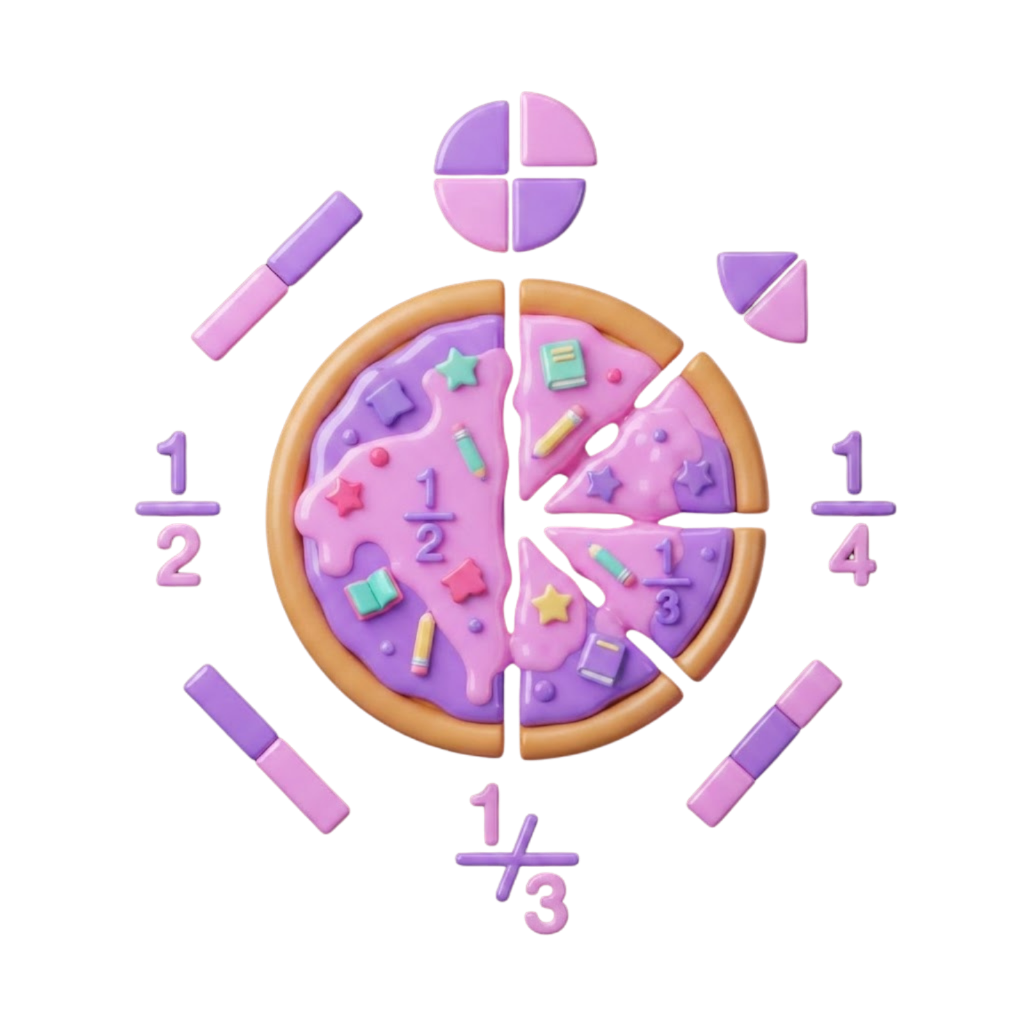
Year 3 to Year 4: The Fractions Wall
Year 3 and 4 are where many students hit their first major Maths wall. The shift from whole numbers to parts of numbers (fractions, decimals, and percentages) is a conceptual leap that some students make easily and others find genuinely confusing.
"Fractions are stupid" — or — "I don't get why 1/4 is bigger than 1/3"
What you'll hear at home
Fractions. Understanding that 1/2 and 2/4 are the same amount, or that 1/3 is bigger than 1/4. Many students assume a bigger denominator means a bigger fraction.
Times tables. By the end of Year 4, students should know their tables to 10x10. Those who do not will struggle with division, factors, and nearly all Year 5+ Maths.
Word problems. The Maths itself may be fine, but translating a worded scenario into a number sentence is a skill many students have not been taught explicitly.
How to help:
Practise times tables daily, even for 5 minutes. Use visual fraction models, pizzas cut into slices, chocolate bars broken into rows. If your child is in Year 4 and still counting on their fingers for basic addition, this is the time to get support before the gap widens in upper primary.

Year 5 to Year 6: Decimals, Percentages & Pre-High School Gaps
Upper primary is where foundational gaps become very visible. If a student has not mastered fractions and times tables by Year 5, every new topic — decimals, percentages, ratios, and measurement — becomes a struggle because they all build on those foundations.
"I hate Maths" — or — "I'm just not a Maths person"
What you'll hear at home
Decimal confusion. Treating 0.5 as smaller than 0.05, or not understanding place value beyond whole numbers.
Percentage blindness. Not grasping that 25% means 25 out of 100, or that 50% is the same as half.
NAPLAN anxiety. Year 5 NAPLAN can surface hidden gaps. If your child's NAPLAN numeracy result was below expectations, do not wait for it to self-correct.
How to help:
This is the last chance to close gaps before high school, where the pace increases significantly. A NAPLAN maths tutor can help with targeted test preparation, while a general primary maths tutor can rebuild the foundations that matter most for Year 7.
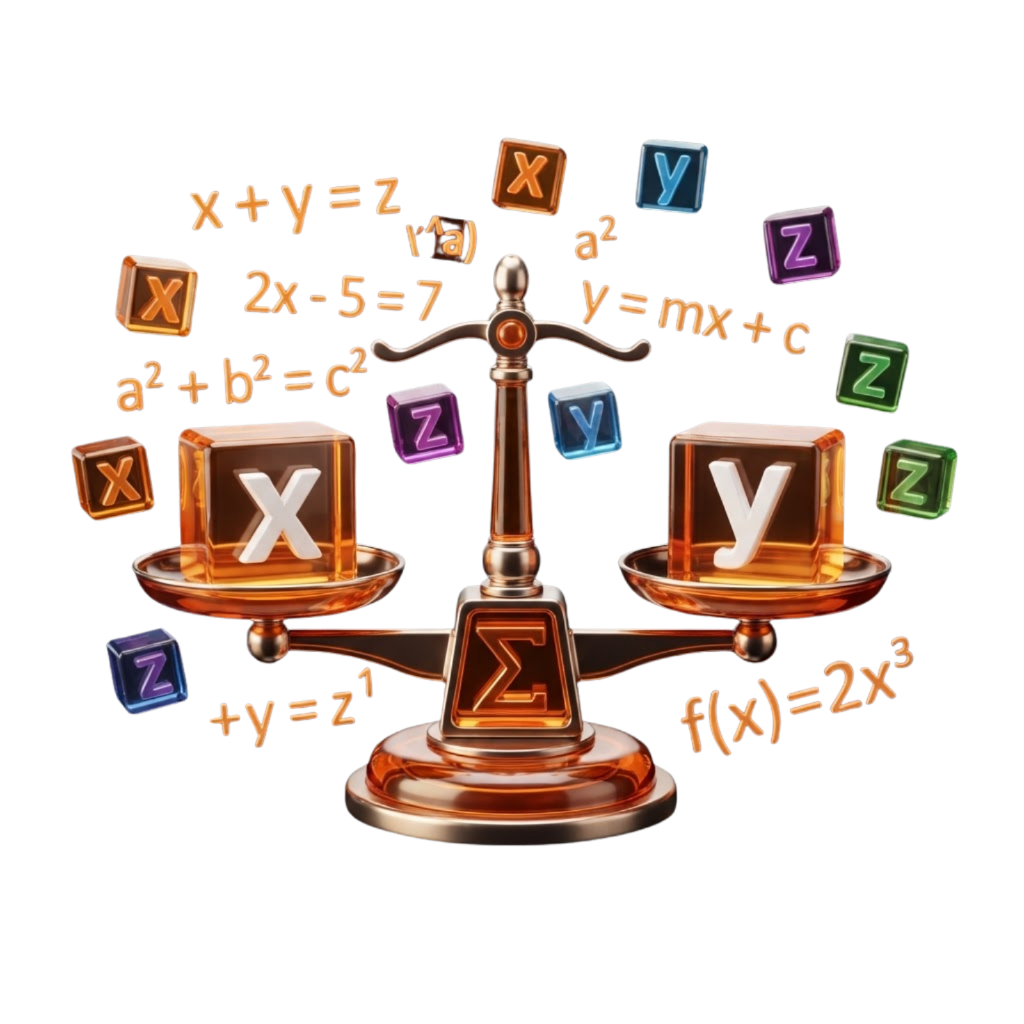
Year 7 to Year 8: The Algebra Transition
The jump from primary to high school Maths is one of the biggest in a student's education. The pace increases, the language changes (letters start appearing in equations), and students are expected to work more independently. This is where many students who were "fine" in primary school suddenly start struggling.
"What even is x?" — or — "This doesn't make sense anymore"
What you'll hear at home
Algebra anxiety. "What is x?" For students who have only ever worked with numbers, the idea of letters representing unknown values is a genuine conceptual leap.
Negative numbers. Adding, subtracting, multiplying and dividing with negatives confuses many Year 7 students. If not mastered, it creates errors in every subsequent topic.
Not showing working. High school teachers expect students to show their steps. Students who do everything in their head lose marks even when the answer is correct.
Pace shock. Year 7 moves fast. A student who misses one lesson on equations can feel lost for weeks.
How to help:
Ask your child to teach you how to solve a simple equation. If they can explain it clearly, they understand it. If they cannot, the gap is conceptual. A Year 7-10 maths tutor can identify exactly where the confusion started and rebuild from there.
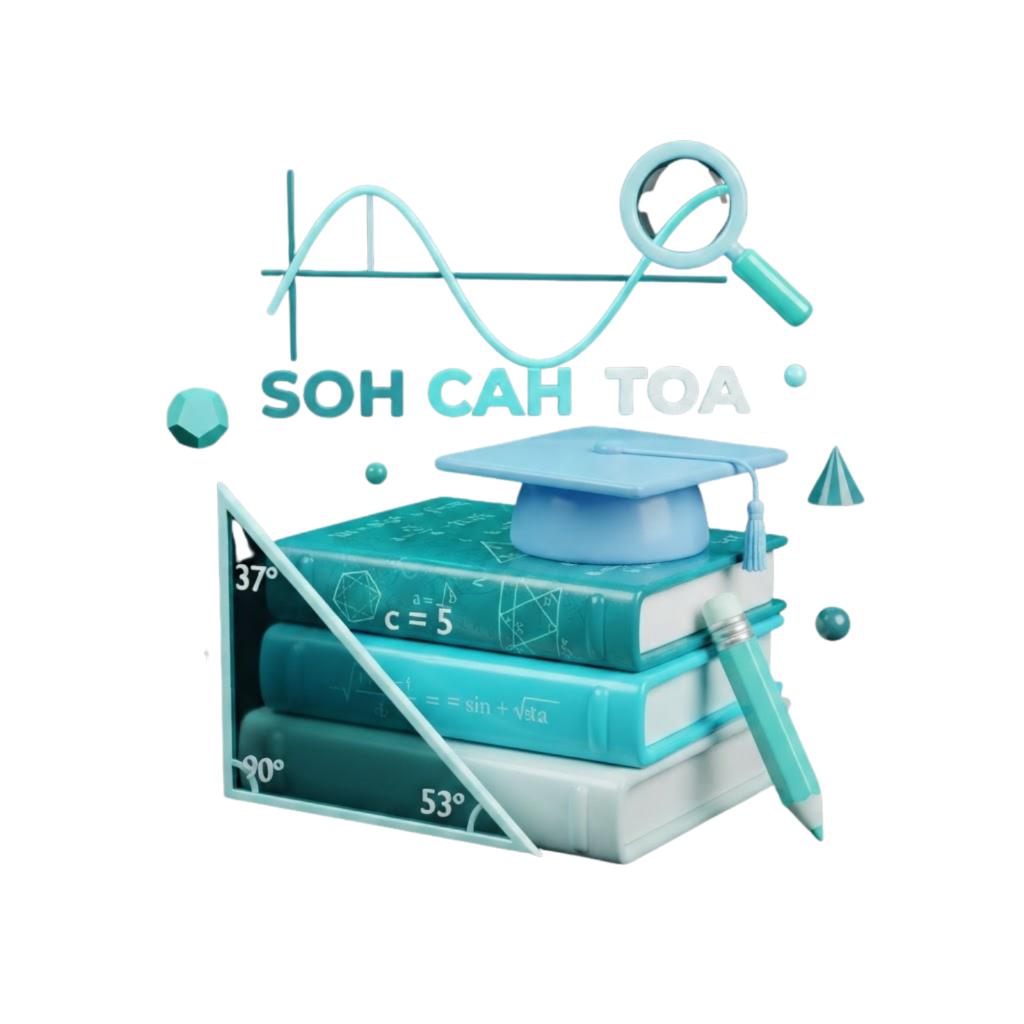
Year 9 to Year 10: Trigonometry, Statistics & The Pre-HSC Filter
Year 9 and 10 are where Maths starts to filter students into pathways. The concepts become more abstract (trigonometry, surds, quadratic equations), and the workload increases. Students who coasted through Year 7 and 8 on natural ability often hit a wall here because they never developed the study habits needed for more complex content.
"When will I ever use trig?" — or — "I'm dropping Maths next year"
What you'll hear at home
Trigonometry. SOH CAH TOA is where many students first feel genuinely lost. It combines algebra, geometry and calculator skills all at once.
Surds and indices. Rules for multiplying and dividing powers feel arbitrary if the underlying concept (repeated multiplication) is not solid.
Study habit gap. Year 10 is the first year where "just doing the homework" is not enough. Students need to revise, self-test, and practise past questions to stay on top.
Pathway decisions. Whether to take Mathematics Standard, Advanced, or Extension in Year 11 is a big decision made in Year 10. A student struggling in Year 10 may limit their own options.
How to help:
Year 10 is a critical year. If your child is considering HSC Maths (Standard or Advanced), their Year 10 results and confidence will determine their pathway. A Year 7-10 maths tutor can help them finish Year 10 strong and set up for a confident start to HSC.

Year 11 to Year 12: HSC Maths & The Band 5/6 Gap
HSC Maths is a different beast. Whether your child is doing Mathematics Standard, Advanced, or Extension, the jump from Year 10 is significant. The pace is fast, the content is dense, and exam technique matters as much as knowledge. The difference between a Band 4 and a Band 6 is often not about ability, it is about study strategy, exam technique, and consistency.
"I'm going to fail" — or — "Past papers are pointless, I'll just read the textbook"
What you'll hear at home
Calculus. For Advanced and Extension students, calculus is the biggest conceptual leap in the HSC. Derivatives and integrals require strong algebra and a genuine understanding of rates of change.
Financial mathematics (Standard). Many Standard students struggle with annuities, loan repayments, and compound interest because the formulas feel opaque without real-world context.
Exam time management. HSC Maths exams are time-pressured. Students who can solve every problem at home but run out of time in the exam are losing marks to technique, not knowledge.
Past paper avoidance. Many HSC students avoid past papers because they are hard and uncomfortable. But past paper practice under timed conditions is the single most effective way to improve HSC Maths results.
How to help:
Encourage your child to start past papers early, from the beginning of Year 12, not the end. If they are stuck on specific topics or running out of time in exams, a HSC maths tutor can provide targeted support, past paper coaching, and exam strategy. Even a few sessions focused on exam technique can move a student from Band 4 to Band 5.
The Pattern: Gaps Compound
Fractions gap
Algebra harder
Trig nightmare
Maths crisis
Fractions gap
Algebra harder
Trig nightmare
Maths crisis
If there is one takeaway from this guide, it is this: Maths gaps do not heal on their own. A student who does not master fractions in Year 4 will struggle with algebra in Year 8, which makes trigonometry in Year 10 harder, which makes HSC Maths a nightmare. The earlier a gap is identified and addressed, the less damage it does.
The good news: The reverse is also true. A student who closes a gap, even a small one, experiences a confidence boost that carries into every subsequent topic. That is why one-on-one tutoring is so effective for Maths — it does not just teach the current topic, it goes back and fixes the root cause.
Signs Your Child May Need a Maths Tutor
Need a maths tutor on the Northern Beaches?
Headstart Tuition provides one-on-one in-home maths tutoring for every year level, from Kindergarten numeracy through to HSC Mathematics Extension. Our tutors come to your home anywhere on the Northern Beaches. The first step is a simple conversation.
Sources & Disclaimer
The information on this page is based on publicly available documentation from NESA (NSW Education Standards Authority) and UAC (Universities Admissions Centre) regarding HSC scaling and ATAR calculation. For official information, visit nesa.nsw.edu.au and uac.edu.au .
This content is provided for educational purposes only and should not be relied upon for ATAR predictions or subject selection decisions. Scaling is recalculated annually by NESA and exact adjustments vary each year. For personalised advice, consult your school careers advisor or a qualified education professional.
Related Quizzes & Free Tools

Related Guides & Resources

HSC Maths Roadmap
20-month plan from Year 11 to Band 6

HSC English Roadmap
Reading, writing & listening mastery

Best HSC Study Practices
Proven habits that move marks

How Your ATAR is Calculated
Scaling and ranking explained

Can One Bad Exam Ruin Your ATAR?
Recovery strategies for setbacks

HSC Study Tips Guide
When to start, past papers & exam technique

How to Find a Good Tutor
A parent's guide to vetting tutors

HSC Subject Scaling Guide
How every subject scales explained
Get free Maths support tips in your inbox
No spam. Just advice on helping your child build Maths confidence, occasionally.